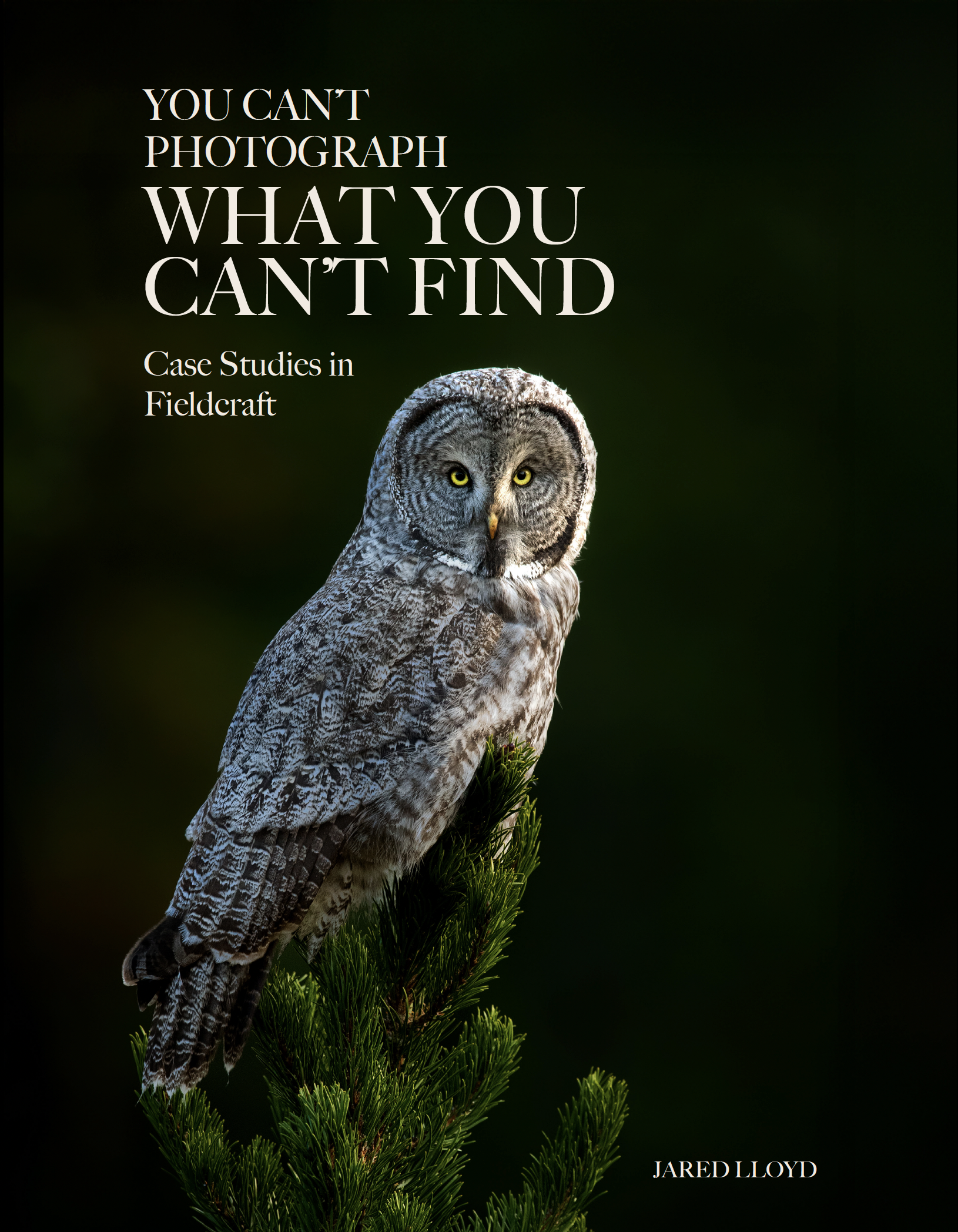
Winter & Wildlife:
Microclimates
by Jared Lloyd
Strapping on my MSR snowshoes, I shouldered my backpack, grabbed a pair of hiking poles, and began the ascent. The trail was snow-packed in some places and ice in others, twisting its way up from Turnagain Arm into the Chugach Mountains.
While literal feet of snow covered the rest of Alaska, this particular stretch of rock and alders and lichens was more ice than snow—hence the MSR snowshoes with their metal saw-like teeth encircling the edges of the hard plastic shoes, the extra beefy crampons under the balls of my feet, and the poles for when I do something stupid and try to take a step while one snowshoe is still pinning the other to the ground.
I was here for Dall sheep. Not just to photograph them, but to understand something fundamental about how animals survive winter's extremes. Because up here, on these wind-scoured slopes, these sheep had solved a problem that kills thousands of animals across the Rockies every year: how to access food when snow buries the landscape.
Some animals seem like they've mastered these challenges. Great gray owls and northern red foxes, for instance, are considered evolutionary masterpieces of winter survival. Great grays have asymmetrical ear openings that allow them to triangulate sound in three dimensions, they can pinpoint a vole moving beneath two feet of snow with supernatural precision. Their facial disc acts as a parabolic reflector, funneling the faintest sounds to those offset ears, and then calculate and readjust based on what researchers call “sound mirages,” working out the mathematical calculations of how snow refracts and distorts sound waves. Red foxes can detect the Earth's magnetic field and use it to calibrate their ballistic pounces through snow. The moment before a fox leaps, it's calculating trajectory based on sound, magnetic orientation, and snow depth simultaneously.
These animals are viewed as some of the most finely tuned winter survivalists on the planet.
But it's only to a point.
When the snowpack reaches around nine inches deep, it creates what we call the subnivean zone between the ground and snow surface. This is where voles spend the winter, scurrying about in darkness, warmed by earth's heat and insulated from winter’s extremes above. Gray owls and red foxes are specialists at hunting these rodents beneath the snow.
But once that snowpack continues to get deeper, these predators are shut out entirely. Great gray owls can only hunt rodents in snow shallower than two feet. For the northern red fox, it’s three. Anything more than that and their extraordinary adaptations become useless. They can't reach their prey, so they move—almost constantly in search of better conditions. And for a great gray owl, that’s often looks like moving hundreds of miles to find areas where snow depth falls back into that goldilocks zone.
I learned this lesson firsthand while photographing great gray owls in Minnesota during one severe winter. In December, when the snow was beginning to accumulate across the southern boreal forest, I was finding great grays two at time in locations. But then I left, heading to Yellowstone in order to lead my annual winter workshops there.
And while I was gone, winter turned deadly fast.
When I returned, that very first night temperatures dropped so low that both of my truck's batteries literally froze and had to be replaced, stranding me at the hotel. The snow was now three feet deep everywhere I searched and the owls had vanished. They couldn't penetrate the snowpack to reach prey below. So, they had left to chase that goldilocks zone wherever it happened to exist, wandering like nomads across the boreal forest as conditions shifted.
The Ojibwe called the gray owl Wa-sha-quon-asin, for this very reason. It means “he who wanders by night.” For come winter, the great gray owl is here today, but gone tomorrow as conditions change.
Needless to say, my plans to post up in Duluth for a couple weeks unraveled fast.
For other animals, however, winter survival strategies are fundamentally different. They don't chase daily weather conditions or wander in search of the right snow depth. Instead, they seek out landscapes that predictably CREATE the right conditions year after year, generation after generation. And then they commit to those places absolutely.
These are the microclimate specialists.

In extreme years across the northern Rockies, mortality rates can be catastrophic. Take the winter of 2023, for instance – the same year my batteries froze in Duluth. While Yellowstone proved to be a winter wonderland for us photographers in January, come March, the snow was still falling at record breaking proportions with no sign of stopping.
The result?
Some 50% of the pronghorns across Wyoming starved to death.
For mule deer, it was 70%.
And across all species of hooved mammals, from pronghorn and mule deer to moose and bison, every single juvenile who had been born the summer before was dead by April.
While this was unique, it lays bare the harsh reality of survival every winter. It’s the reason animals will instantly change their behavior and throw caution to the wind when the barometer falls. It’s why some animals sleep through the winter, and others flee for their lives each year. It’s why ecosystems simplify. And it’s why the movements of animals become predictable so long as you know what you’re looking at; so long as you understand the concept of microclimates.
And this was why I was clambering up a slope in the Chugach Mountains of Alaska with mountaineering style snowshoes strapped to my fight, as the pack ice of Cook Inlet and Turnagain Arm ebbed and flowed with the tide down below.
You see, mountain sheep are masters of this knowledge out of necessity. Whether we are talking about Dall sheep in Alaska or bighorns in Montana, these animals always exist on a knife’s edge. Even in the summer, most of these animals live above treeline, at elevations that can see three-foot snowstorms in August. And to survive, mountain sheep develop an obsessive fidelity to very specific locations; places they return to year after year, generation after generation, because these sites guarantee survival.
And the secret to that survival is southwest-facing slopes.

In the northern hemisphere, the sun is always somewhere in the southern sky. Come afternoons, temperatures hit their highs for the day when the sun is beating down from the southwest. For this reason, southwest-facing slopes receive more solar radiation than any other place in the mountains.
But that’s not exactly why mountain sheep and other wildlife flock to these southwest facing slopes.
It’s the wind.
Wind is created from uneven heating. When southwest slopes bake in afternoon sun, they warm faster than the surrounding landscape. As everyone knows, hot air rises. But what you might not know is that as it rises it creates a vacuum that colder air comes rushing in to fill. This is how wind is created. One place warms faster than another, the heat rises, and cooler air rushes in to fill the void.
The warmer the air is compared to the surrounding area, the faster it rises. And the faster it rises, the stronger the wind that’s created to fill the vacuum.
In the mountains, it doesn’t matter if two feet of snow fell overnight. When those clouds part, when the storm passes, as soon as solar radiation warms those southwest facing slopes, the wind will kick up. And two feet of snow becomes a mere three inches in short order.
For this reason, mountain sheep both summer and winter in locations where sun, warmth, and wind combine to create a microhabitat that is guaranteed to always have the least amount of snow. So, it’s no coincidence that this Dall sheep hotspot outside of Anchorage, Alaska, happens to be called Windy Corner.
Back on that Alaskan mountainside, I finally spotted what I'd climbed for: a group of rams bedded on a patch of snow-free, lichen-covered rocks. While the valley I drove down from held more than three feet of snow, up here the wind had scoured the slope nearly bare. The sheep were surrounded by exposed forage, completely unbothered by the windchill and brutality of life on these exposed slopes.
This is the fundamental strategy for winter survival, both for wildlife and wildlife photographers: know your microclimates.
Most people live nowhere near mountain sheep, of course. So how does understanding Dall sheep and bighorn behavior translate to understanding wildlife elsewhere?
The principle remains the same. Winter creates universal challenges for all species: how to find food and how to survive the weather. And every animal solves these problems by seeking out favorable microclimates to the best of their ability.
One side of a farmer’s field will be warmer than the other. Deer will move into dense conifer forests to find protection from high winds. Meanwhile a section of marsh exposed to prevailing wind will remain ice free and filled with ducks because the rest of the area freezes over and becomes a desert. Screech owls choose southwest facing cavities to roost in through the winter because it’s warmer. Eagles predictably concentrate in areas through the winter where water remains open and fish accessible which is why places like Conowingo Dam and Kachemak Bay are world renowned. Manatees in Florida congregate around warm water springs. Alligators seek access to deep water with southern exposure.
The concepts repeat themselves over and over again. Animals, survive the winter by seeking out microclimates.
It’s time to completely rethink our approach to wildlife photography.
Download our Case Studies in Fieldcraft to learn exactly how to do just that.