
Be A Better Naturalist: The Science and Fieldcraft of a Super Mast
By Jared Lloyd
The silence hit me first. September in southwest Alaska should pulse with the sounds of leaping salmon and the explosions of brown bears launching themselves through the shallows after those fish. Instead, I stood on the bow of a small boat donning chest waders, staring at empty gravel bars beside a lake thick with spawning sockeye, wondering where 20 years of fieldwork experience had gone wrong. The hyperphagia season was in full swing. Bears should have been packing on 30-40% of their body weight in these crucial pre-winter weeks. The spawning beds before me should have held 800-pound boars and protective sows with cubs in the wings.
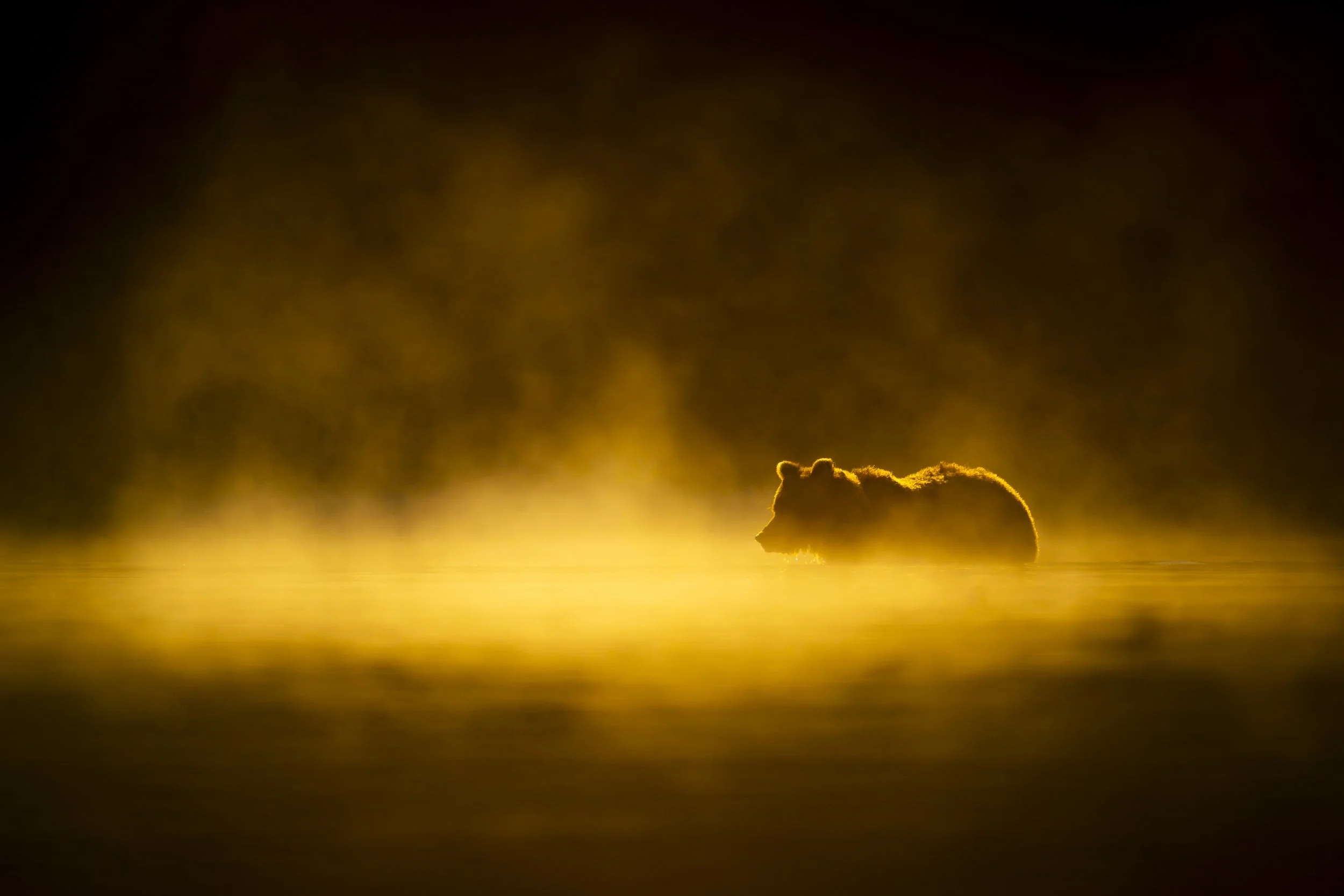
But the bears had vanished.
The mystery unraveled when hopped out of the boat into the water, waded ashore, and knelt beside a fresh pile of bear scat on a nearby beach. The dark masses were packed solid with red berries and seeds: highbush cranberries. I rolled the scat between my fingers, counting seed types like a detective gathering evidence. Devils club. Red elderberry. And what appeared to be blueberry skins. The red stains on my fingertips told the story before my brain caught up.
A short bushwhack into the alder thickets along a well-used bear trail confirmed what the scat had revealed. I quickly reached a sweeping stand of highbush cranberries that seemed to encompass all of Alaska, and millions of berries hung heavy on every bush, bending branches toward the ground with their weight. In two decades of Alaska fieldwork, I had never seen anything like it. The red highbush cranberries where so dense they looked like Christmas ornaments. Glancing up the mountain that ascended before me, blueberries carpeted the alpine tundra that crept up the mountains in purple abundance. Alaska’s berry species had synchronized their production in a super masting event, and every bear in the drainage had abandoned the protein-rich salmon for fruit.
Despite the popular misconception, bears in Alaska need far more than just salmon this time of year to survive hibernation. The ratio of macronutrients that bears need to survive the winter is shockingly specific. Too much protein means their bodies can’t build up the fat reserves needed to survive the winter and they can’t control insulin levels in hibernation. Too much sugar and their muscles atrophy through that same time period. Basically, if they eat too much protein, they run the risk of starving come winter and if they eat too much sugar their muscles will atrophy, and they will starve after hibernation. So, bears average a macronutrient ratio of roughly 17% protein, 45% fat, and 38% carbohydrates during hypherphagia to survive the coming winter.
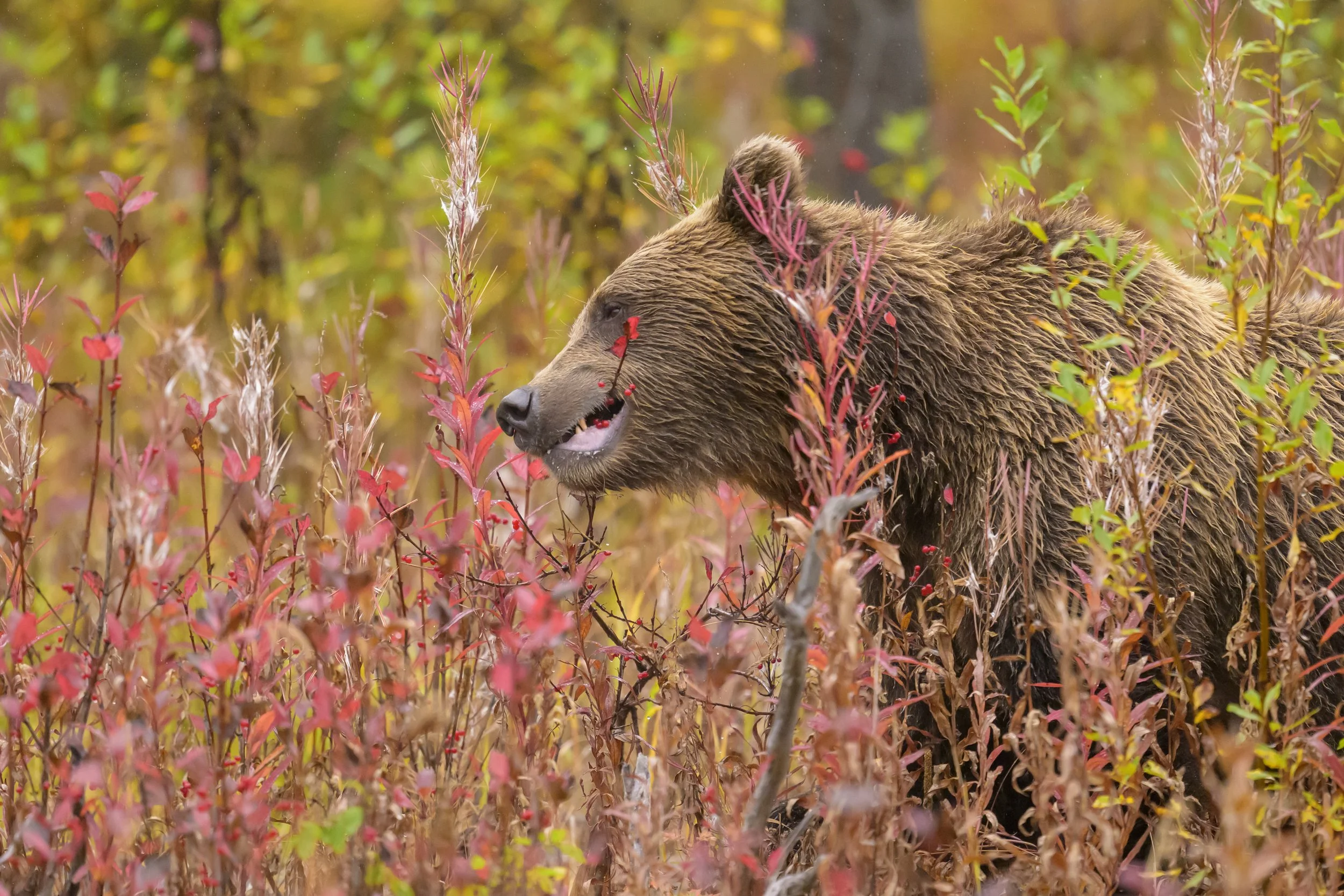
When there is a good crop of berries, bear numbers will dwindle. You’ll find a few, but things will feel “off.” But when there is a synchronous masting event like this, every bear seems to disappear overnight. On a normal day this time of year, I expect to see at least 20-30 brown bears in this location. But every single bear had walked away from the guarantee of salmon to focus their attention on the brief window of opportunity to max out their carbohydrate needs.
Understanding this ecological shift changed everything in the field. In years past, I had concentrated my efforts where this natal sockeye lake spilled out into a great river that coursed through the mountains and out to sea. But mountains and valleys and glaciers and ice fields and oceans and even that looming active volcano towering above me, all create their own microclimates. Here, large balsam poplar and paper birch mixed with willows and both highbush and lowbush cranberries. This is still boreal forest. It’s warmer. Wetter.
Another 10 miles up the valley, everything is different. The microclimate created by glaciers and steep mountains dictates an altogether different world compared to my usual haunts. Here, blue hanging glaciers can be seen above. We trade willows for alpine tundra that descends right down to the waters edge. Because the season progresses a few weeks earlier here, cranberries should be almost non-existent, and the blueberry crops up the mountain sides should have already been exhausted.
Honestly, I had never been up there and neither had the guide I hired to run the boat – despite some 20 years of fishing these waters. But this didn’t matter. Understanding how geology drives biology, one could make a cursory glance in that direction and come the conclusion that things would be colder, that winter should come earlier there.
After a thirty-minute run across the turquoise waters that characterize glacial lakes everywhere, we eased into the headwaters as the lake split into a labyrinth of waterways and wetlands. Here, things were indeed different. Katabatic winds surged down from the glaciers, bring the deep chill one would expect from ice chilled air. The colors of the willows were further along. Sure, there were a few stands of devil’s club and red elderberry concentrated around the edge of a pond where beavers had dammed one of the creeks, but this was normal.
And here I found bears hunting salmon.
What could have been a disaster, especially since I had two workshops to lead, became some of my best photography of the season, all because I read the landscape through an ecological lens rather than fighting against it.
This is fieldcraft. And this is why ecological literacy matters.
Nature’s Boom and Bust Cycles
What I experienced this September in Alaska is called a synchronous masting event. If you have never heard of this before, you’re not alone. Most people haven’t.
Masting, sometimes called “mast seeding,” refers to the highly synchronized production of seeds or fruits by a population of plants in certain years, followed by little or no production in others. These irregular pulses of abundance occur simultaneously across vast areas, creating ecosystem-wide ripple effects that influence animal behavior, nutrient cycles, and even forest structure.
Masting represents one of nature’s most sophisticated resource management strategies. Rather than producing a predictable annual crop, masting plants create dramatic feast-or-famine cycles, flooding ecosystems with seeds, nuts, or berries every few years. This boom-and-bust approach directly impacts wildlife behavior and therefore wildlife photography opportunities.
During mast years, plants overwhelm seed predators (if you can think of a whitetail deer as a predator) with far more food than those animals can consume. This ensures at least some seeds survive to establish the next generation. The lean years that follow also help to keep populations of those same animals suppressed, further improving long-term seed survival. For photographers, this creates predictable patterns that repeat across decades.
Masting events happen all over the world. And while my above story focused on a far flung and remote area that few will every see or experience, there is a massive synchronous masting event happening right now across the Appalachian mountains in the form of oaks and acorns; a fact that means this should be one of the best years in a long time for photographing black bears, eastern turkeys, and whitetail deer across the East – as long as you know where to look.
The most reliable predictor of oak masting involves what scientists call the delta-T model. This examines temperature differences between consecutive summers. When current summer temperatures exceed the previous year by significant margins, trees interpret this as a masting trigger and begin investing extraordinary energy into producing seeds.
The 2025 acorn explosion across the Appalachians illustrates this idea. Virginia’s Department of Wildlife Resources reports white oak production indices of 22, well above the long-term median of 10.2 and dramatically higher than 2024’s disappointing 8.6. The warm, dry April provided optimal pollination conditions, while subsequent hot summer temperatures triggered widespread masting across the region.
This is huge.
Let’s forget the numbers I mention above and just put this in simple terms: this year’s acorn production is the biggest event in more than 10 years. Meaning, this year stands to be the most significant chance you have had to find and photograph species that depend on white oak acorns in the last decade.
If irruptions are the holy grail of finding and photographing northern forest owls (more on this in the next issue of PhotoWILD), masting events like this year in the Appalachians are the equivalent for black bears, turkey, and whitetail deer. In other words, if you have access to places like Shenandoah and Great Smoky Mountains National Park (to name only two black bear and whitetail deer hotspots), then you need to get there immediately!
What makes the current 2025 Appalachian mast so exceptional isn’t just its magnitude, but its timing and composition. This year is specifically a white oak phenomenon, and that distinction matters more than you may realize.
White oak acorns represent the difference between wildlife tolerating a food source and craving it. To put this into a more human-centered perspective, it’s the difference between eating Spam or a ribeye. Both are meat (hypothetically), but they are clearly not the same.
While red oak acorns contain high levels of tannic acid that make them bitter and astringent, white oak acorns are naturally sweet with very few tannins. Research shows that every species of animal that eats acorns has an overwhelming preference for white oak acorns. For white-tailed deer, these acorns make up 75% of their diet when available. And black bears will consume 20,000 calories a day from these acorns alone.
White oak acorns contain concentrated carbohydrates that provide the energy wildlife need to prepare for the winter, along with complete proteins containing all nine essential amino acids. This nutritional profile makes them even more attractive than corn and other agricultural crops. Much like the berries in Alaska, black bears and deer will abandon every other food source when white oak acorns become available.
Think of white oak acorns as nature’s candy bars combined with a protein shake. The immediate energy boost from simple carbohydrates paired with essential nutrients creates an irresistible combination that drives wildlife behavior in ways few other natural foods can match.

White oak acorns are one of the most important food sources in the deciduous forests of the Great Lakes and Eastern US. While not as abundant as the red oaks, the acorns produced by this tree are sought after by most animals in the forest. Find the white oak stands, and come fall, you will find the wildlife.
We’re currently in the middle of the absolute peak of the acorn mast. White oaks typically drop their acorns from September through early November, with peak production occurring in early to mid-October. But unlike red oak acorns that drop slowly over months, white oak trees release their acorns almost all at once and can completely carpet forest floors within a matter of days.
All of this means that timing is of the essence for photographers. White oak acorns don’t lay around like their red oak counterparts. The low tannin content that makes them palatable also means they lack natural preservatives, causing them to rot or sprout within weeks of falling. Wildlife recognizes this narrow window and concentrate their feeding accordingly, creating photography opportunities unlike anything else in the woods.
Current field reports from across Appalachia confirm that peak drop is occurring right now, in mid-October 2025. But the warm, dry conditions that triggered this mast event are also speeding up the timing of everything, with many areas seeing their heaviest acorn drops 1-2 weeks earlier than normal. This means that you have perhaps 3-4 weeks remaining before the window closes and wildlife disperses again.
What This Means for Your Photography
Get to the mountains quickly and forget about the usual wildlife photography hotspots – unless they contain large stands of white oaks.
Look for mature white oak trees on southeast-facing slopes especially between 2,000-4,000 feet. These areas get the best sun exposure and tend to have the most consistent acorn production. Focus on trees with thick trunks, 24 inches diameter or larger. These are mature trees that will produce the biggest crops.
And look for poop.
The sign is everywhere once you know what to look for. Bear scat changes completely during heavy acorn feeding, becoming dark brown and packed with shell fragments. Deer trails will converge on productive oak groves from every direction. You’ll find claw marks on smooth bark where bears have climbed 30 feet up to reach canopy feeding platforms.
This is the kind of wildlife photography opportunity that comes along every 5-10 years if you’re lucky. The combination of a super mast and years of pent-up wildlife demand thank to bad acorn production over the last decade is creating conditions that likely wont happen again for a while.