
From Currituck to the Dakotas
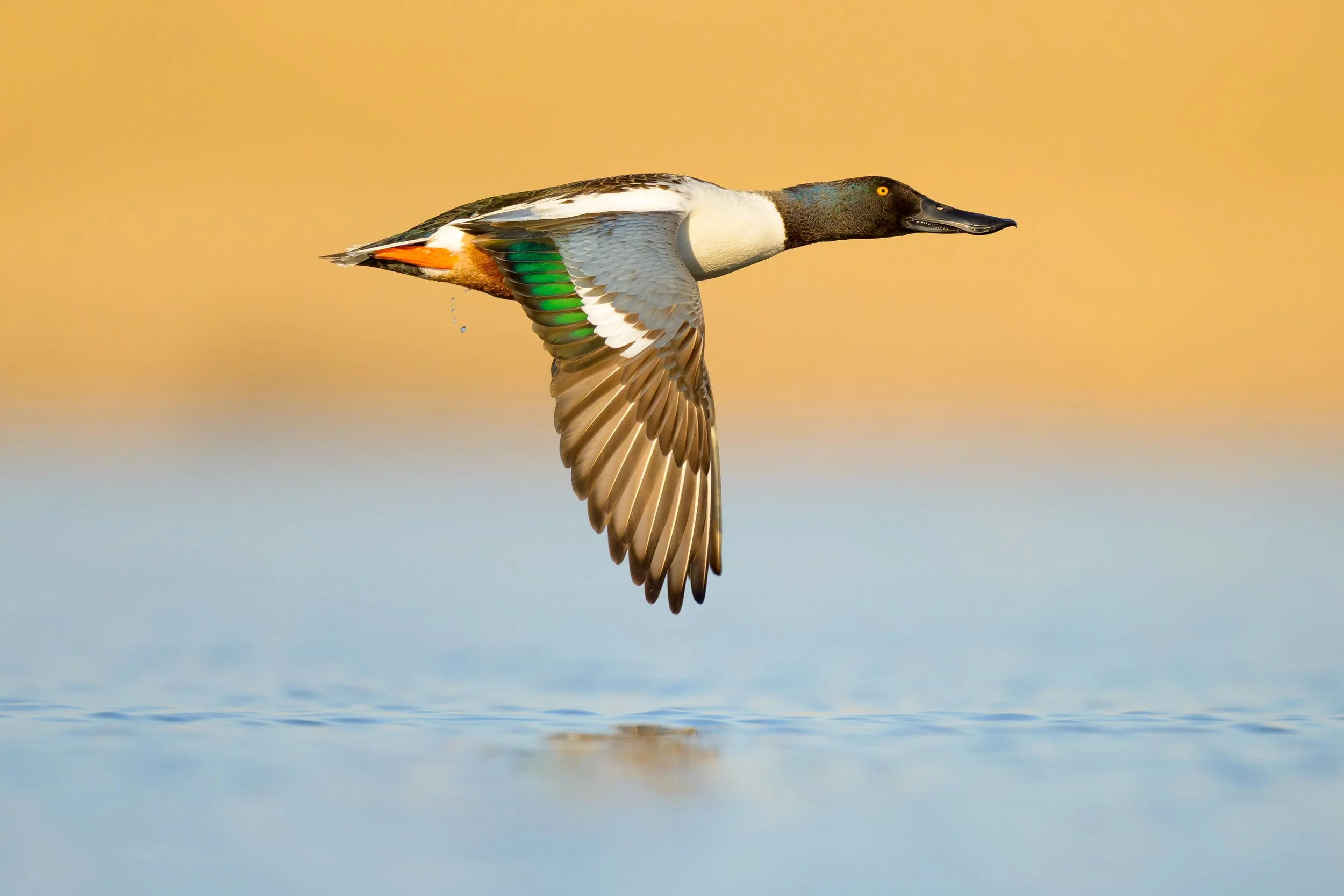
A northern shoveler flys low above calm waters out on the prairie in the afternoon light. The golden hues of the surrounding sea of grass created an ethereal look and feel to the composition - one of those artistic qualities this landscape offers if you know how to look for it.
I grew up on the banks of the Currituck Sound, a place where waterfowl are inextricable from the culture, history, and identity of both people and place. In the world of duck hunting, the birds on this estuary are the stuff of legend, and it was here that I cut my teeth as a professional photographer. My obsession with ducks was never a choice.
There’s a name stamped on the landscape where I come from. It's on bridges. It's on middle schools. It's even on the building that houses the School of Government at UNC Chapel Hill.
That name is J. P. Knapp.
Like many well-heeled northerners of the 19th and early 20th century, Knapp was lured to the Currituck Sound by the legendary flocks of migrating waterfowl that wintered along its shores. The gun clubs here held member rosters that read like a who's who of American power: industrialists like Andrew Carnegie, J.P. Morgan, Vanderbilt, and the Rockefellers; presidents like Theodore Roosevelt, Grover Cleveland, Benjamin Harrison, Dwight Eisenhower; the boxer Jack Dempsey, and George Bird Grinnell – the founder of Audubon and the guy you can also thank every time you see a bison in Yellowstone. The longest-running hunting club in America, the Currituck Gun Club, still operates here. The world's first hunting club to admit women still stands as a museum in the town of Corolla – pronounced Kuh-RAH-la, in case you didn't grow up here.
But the relationship with waterfowl here runs deeper than any gun club. The name Currituck itself is Carolina Algonquian for "place of many geese."
On certain winter mornings you can watch tundra swans stretch across two miles of open water between the barrier island and the mainland so thick it feels like you can walk across on their backs. Today, this stretch of North Carolina plays home to 75% of the tundra swan population that nests from Nome, Alaska, and all points east – totally some 100,000 of these birds. Snow geese are the same, drawn to this area for the same reasons as the swans, thousands can be found here feeding in the marsh. And then there are the ducks. Historically, it was likely over a million. People referred flocks as "smoke,” because when fifty-thousand birds lifted off together, the sky filled with what looked like dark columns of smoke rolling up from a marsh fire.
By the early 20th century, those flocks were disappearing. Market hunters had engineered a weapon of mass destruction called the Punt Gun – essentially a homemade ten-foot cannon mounted on the bow of a boat and packed with up to two pounds of shot. To put that in perspective: a modern duck hunter loads roughly one ounce. A single Punt Gun blast could drop fifty to a hundred birds. Scores of hunters worked the Currituck in teams, running multiple guns across the marsh, filling barrels to be taken to Knotts Island and the sold up for meat from Virginia to New York.
The birds never had a chance.
Knapp saw what was coming. There was no such thing as wildlife protection at this time. The Lacey Act that would ban the commercial sale of wild game except for fish was still a ways off. So, Knapp enacted bag limits on his own marshes to restrict the numbers of birds that hunters could shoot. This was the first "limit" on “game” in American history.
But one gun club’s private marshes are only going to go so far. Knapp went to the other clubs and made the argument that if nothing changed, the ducks wouldn’t survive the decade. The other gun clubs agreed and followed his lead. They imposed limits, set aside refuges in their marshes where hunting was not allowed, and they even began captive breeding programs on their properties as a means of trying to offset the wholesale destruction of wildlife at the hands of market hunters. In 1927, with Knapp at the helm, the hunting clubs along the banks of the Currituck Sound made their alliance official and formed an organization called More Game Birds in America.
Ten years later, they changed the name to Ducks Unlimited.
This was my backyard. This was the history of the water I grew up on. These were the people whose names were on the bridges I drove across. Theirs was the money that founded the schools I went to. The great swaths of National Wildlife Refuges in the area I photographed in and have protected huge stretches of the Outer Banks from the cancer of the McBeach Mansions were the old no hunt zones these clubs created with their private holdings: Mackey Island NWR was Knapp’s property, the Currituck Banks NWR was Swan Island’s, the Pine Island Audubon Sanctuary was the Pine Island Gun Club. That legacy is inextricable from the stories and culture of the Currituck Sound today.
I remember when I was notified that I had landed my first cover for Ducks Unlimited magazine. My eyes filled with tears. I remember shaking. I couldn’t speak. To this day, that cover shot remains one of the most meaningful moments of my career. Not because of the $1,800 check I cashed, but because of where I came from. I was a photographer whose professional work had been born on the same marsh and water as Ducks Unlimited itself. I was 32.
Growing up, I had heard about the Prairie Potholes my entire life. This is where ducks come from. People called it the Duck Factory, a glacially-scoured complex of wetlands stretching across the Dakotas, Minnesota, Iowa, and deep into the Canadian prairies, where some 80% of all the waterfowl in North America are born. As Ducks Unlimited evolved over the decades, its focus shifted from protecting wintering grounds to protecting the places ducks are actually made. And the place that mattered most was the PPR.
We now recognize the Prairie Potholes Region as the most important wetland complex on earth. We also know that it is the most ecologically devastated landscape in the lower 48 states, with around 90% of its critical habitat already drained and converted for industrial agriculture. And yet it endures. The potholes are still the birthplace of up to 80% of North American waterfowl, 30% of all shorebirds on the continent, and a critical stopover for more than a billion migratory birds.
Having spent a lifetime in chest waders watching the world wake up around me in frozen marshes, working from brush blinds and ghillie suits and kayaks draped in camo, in late 2019 I bought my first proper floating blind. I had been watching European photographers use them to capture extraordinary images of grebes on that continent's shallow lakes and I recognized immediately what this could do for photographing ducks in North America, with a few modifications.
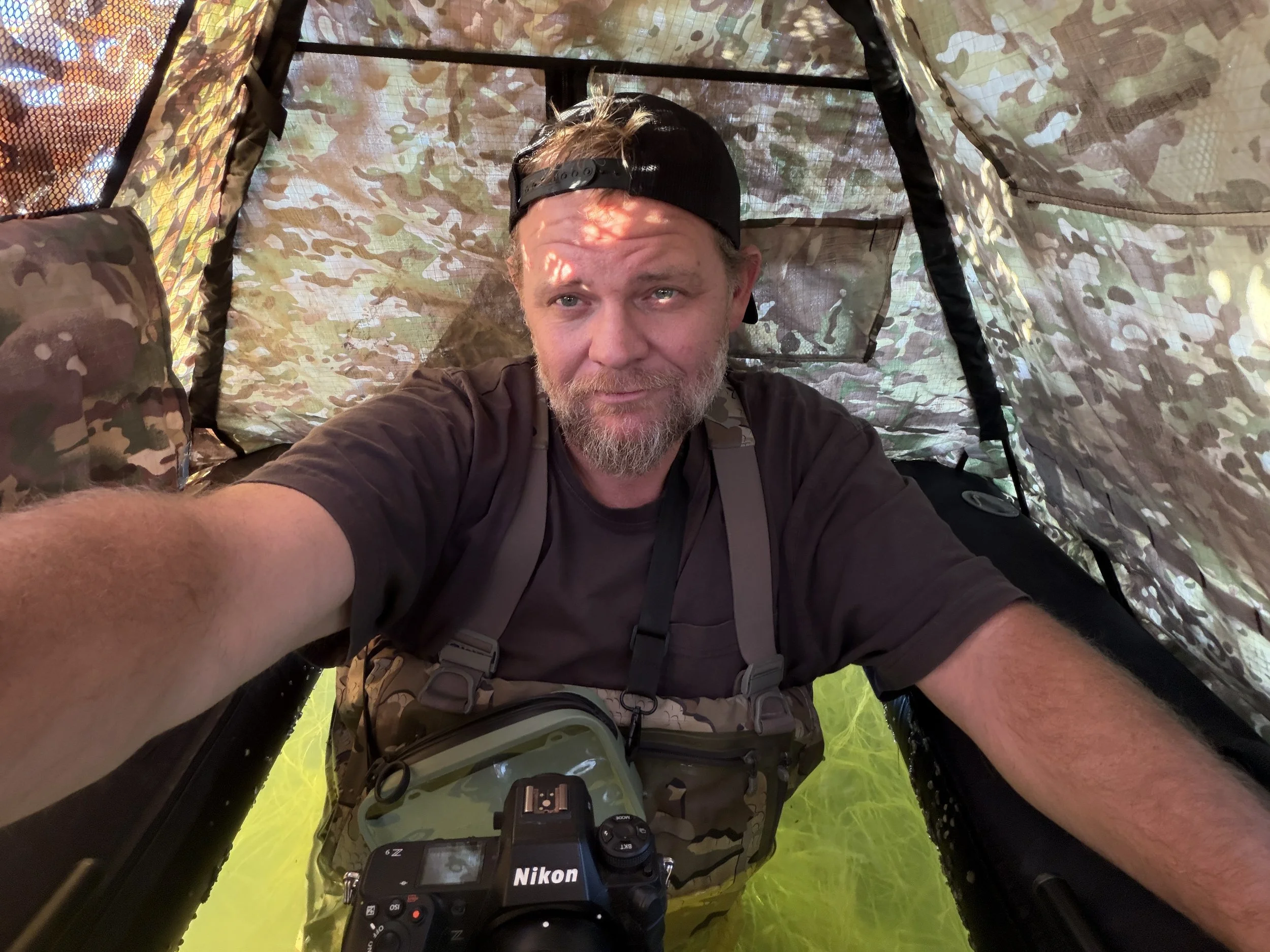
Dog tired from traveling from Panama to North Carolina and then immediately undertaking a 3 day drive to North Dakota. I rolled into my hotel room, emptied my truck, and rushed out to being scouting after finishing my 12 hours of driving for three day in a row. Out here in the cold waters of early spring in the immensity of the endless rolling prairie, I couldn't be happier.
My plan was to go straight to the Dakotas that spring. I was living in Montana. My in-laws were Lakota and resided where their people always had - in the heart of the PPR of North Dakota. What I had seen of this region had been explored while riding around with them on reservations and private property in the eastern Dakotas, and I had been dreaming about working these waters for years. But a global pandemic had other plans.
It was 2023 before I finally slid a floating blind into a cattail-lined hemi-marsh in North Dakota. I had come to feed my own obsession and the library of images I license to organizations like Ducks Unlimited, Delta Waterfowl, the Nature Conservancy, and World Wildlife Fund. But within minutes, I knew the Prairie Potholes would change how I planned and ordered my life for many years to come.
Being back in the PPR as I am right now, is the continuation of something that began on the Currituck Sound more than two decades ago when I was in my early 20s. Few people know this about me, but ducks are what started my career. These are the birds that first made me want to do this for a living. And when I’m not traipsing around places like Alaska or working with researchers in Panama (more on this to come), to this very day I am still thinking about ducks, watching marshes for pintails, searching tree cavities near the edge of beaver ponds for buffleheads, or thinking about the millions of birds I have seen over my life and how most of them came from one of these quiet and unsuspecting little ponds on the prairie.