
Every Photo Is A Lesson In Fieldcraft
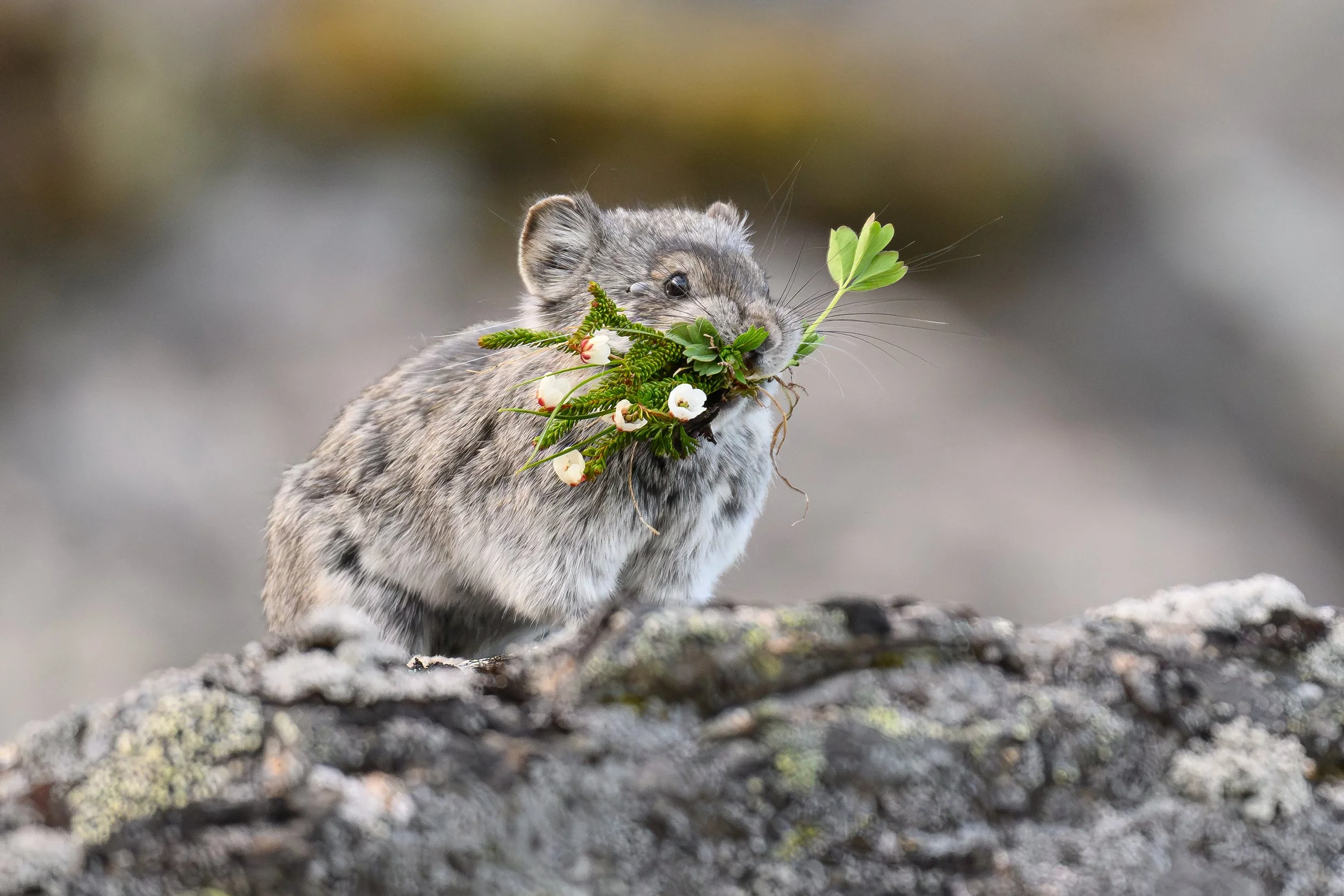
I recently shared an image on Facebook of a collared pika I photographed in Alaska with a bouquet of flowers in his mouth like he was heading to the prom.
As is my habit, the post on Facebook was all about the fascinating behavior and what researchers consider to be the most sophisticated knowledge of pharmacology in the world outside of humans. Pika harvest toxic species of plants like the arctic heather in the photo to layer through the winter stores of food. As the phenolic compounds break down, and leach through the haypile, they work like a natural food preservative, protecting the cache from fungi, bacteria, and other parasites that would ruin a winter's worth of food.
Pika know what they are doing. They select plants of different toxicity and layer them accordingly so that by the time they have eaten their way to that part of the haypile, the toxins have broken down enough to be harmless to the pika.
In other words, good old fashion nature nerd gee whiz type stuff.
But here, I want to discuss what it took to actually create the image.
If you have followed my work for any amount of time, you likely know I feel that listing basic exposure data doesn't do a damn thing for teaching people about how a photo was created.
It's a bit like assuming you can learn how to be a better wildlife photographer by studying the metadata.
"Hmmm, oh yes. ISO 3200. It all makes sense now. Eureka!"
As if anyone says "Eureka!" in this century.
But how we found the subject, how we approached them, how we were able to anticipate their behavior, and how we worked through the composition? Now that is a very different story.
So, let's dissect this photograph, because every image can be a case study in fieldcraft.
Pika aren't confined just to Alaska. Technically, there are 30 different species in the world with most found in Asia. Here in North America, however, we have two.
This species, known as the collared pika, is found in Northern British Columbia, the Yukon, the Northwest Territories, and Alaska. In Montana, for instance, along the Beartooth Highway – which is one of the best places in North America for photographing pika – you find the American pika.
Access is important. While these little fluff balls aren't particularly scared of people once they acclimate to your presence, getting to them can be a real challenge because they live above treeline.
In Denali National Park, that's not a problem. Even the valleys are above treeline there. Find a sweeping pile of rocks and you're likely to find pika. But this wasn't from Denali. I photographed this little guy in a place called Hatcher Pass outside of Anchorage in the Talkeetna Mountains.
Despite the elevation, despite the literal meters of snow that characterize their homes in the winter, pika don't hibernate like the other animals who spend the winters up here. For this reason, the collared pika spends every waking moment through the summer gathering supplies for the winter.
And this means they have a very predictable pattern of behavior you can anticipate, set up for, and wait to capture images like the one I shared above.
These winter stores are called haypiles, and they can be massive compared to the size of the pika. By September, haypiles average about 12lbs of dried food and measure a meter or so in size. This means that pikas maintain an almost constant habit of running back and forth, harvesting plants, and scurrying them down to the haypile for months on end.
You know when you're in pika land because of the high-pitched squeaks you hear before you ever see the animals. If you're observant, you will also start seeing the trails that run in and out of the rocks.
As I approached the outcropping of scree and small boulders set amongst a sea of spongy high alpine tundra filled with tiny flowers in all directions, I watched for small trails along the ground that would help me pinpoint the vicinity of a pika's lair. Think of these trails like bicycle spokes all pointing back to a hub.
There were several pika that were making a living around this outcropping, along with hordes of arctic ground squirrels, and all eyes were on me.
I traced the bicycle spokes to a tangle of boulders I suspected was the epicenter of activity, found a place to sit down and kick back in the carpet of 2-inch-tall flowers, and waited.
Within a few minutes, the colony of pikas were back at it again and the arctic ground squirrels were already coming over to check me out.
This is an important strategy in wildlife photography. I don't like to hide from the animals I'm photographing. Really, there's only one group of animals that attempts to get close and hide, and that's predators.
If I feel like I need to hide myself, then I'm generally working from blinds.
All animals live in a multi-ethnic neighborhood. They are used to a menagerie of different species being around. Some of those neighbors are big. Some are small. Some are dangerous, others are completely benign. The only neighbor who is trying to sneak up on them is usually the one that's also trying to eat them.
So, by and large, I want my subject to know I'm there and then give them a chance to make the decision that's OK.
And with pika, that means sitting down and having a bit of patience.
Most animals are like this actually. Get in, sit down, shut up, and give it 20 minutes. That's usually all it takes before an entire ecosystem's collective cortisol levels drop back down and the world returns to business as usual all around you.
Once the pika began their foraging runs again, I took mental notes of how and where they moved back to their underground lairs. Pikas are creatures of habit. They have their preferred routes to get back home, which accounts for the little trails. But they will even go so far as to hop atop the exact same 4 or 5 rocks every single time they come back, pausing for a moment to scan for danger before the final plunge beneath whatever series of rocks their haypile is hidden beneath.
That's the secret sauce of photographing these little guys: knowing exactly which rocks they are going to jump on top of to scan for danger before diving beneath the boulders again.
As soon as you locate those rocks, you can decide which one is going to offer you the best composition, which one has the best background, which one is going to offer you the best angle of view, which is going to let you separate the subject the easiest.
The reactive photographer just sees a pika hopping around and tries to capture photos. They fumble with autofocus settings because suddenly they're trying to keep up with something the size of a fist leaping behind boulders that seems to be moving at speeds approaching the sound barrier.
The proactive photographer on the other hand, is thinking about the entire story playing out before them. They notice the different paths that pika are going to use coming and going, they get a rough idea of where the haypile is likely hidden, they watch the activity long enough to recognize patterns and learn which rocks serve as sentry posts along the route back to the haypile. And they begin sizing up these different rocks to determine which will likely offer the best photographs.
This isn't unique to photographing pikas.
It's just the standard protocol for working with wildlife and having control over our own compositions.
People like lists, so let's distill this down for the sake of simplicity because regardless of what animal you want to photograph, it's a bit of a standardized process.
Find the animal by first understanding where the animal is most likely going to be.
Let the animal acclimate to your presence.
Observe with the intention of recognizing patterns in the behavior and what's happening.
Identify the different compositions that might be possible.
Choose the best one, put yourself in place, and wait for the photograph to unfold.
It's ecological literacy + observation + patience = the ability to pick and choose and design the compositions you want to make.
That's the fieldcraft.
Without this, the opportunities become fleeting. The technical considerations are being made on the fly. And your camera's autofocus plays a game of tug of war with the surrounding landscape.
With my pika, I had 3 second windows to capture a photograph because that was about the length of time they would pause on their sentry rocks. One Mississippi, two Mississippi, three Mississippi, gone.
But three seconds is an eternity when you know where the pika is going to stop and already have the composition lined up.
I made a lot of images that afternoon.
But what I wanted was this shot. I wanted a collared pika perched on a rock with a bouquet of toxic flowers in its mouth. I wanted the cuteness factor woven together with the ecological story it tells. And instead of just accepting what I stumbled across, I sat down and observed first before ever lifting my camera.