
The Migration is Now
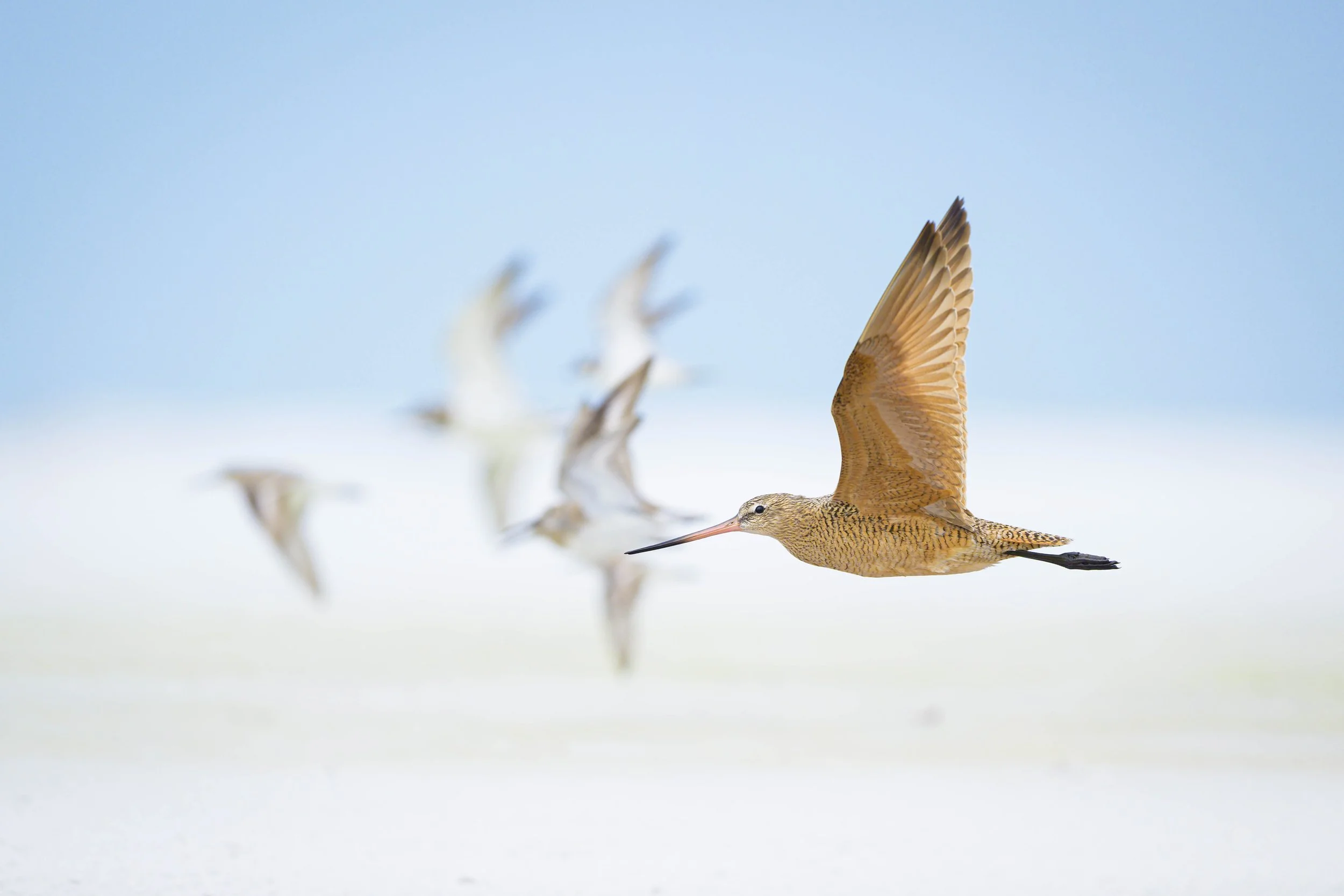
A marbled godwit in a mixed flock of other shorebirds during migration
Fun fact: the fall migration has been happening since the summer solstice.
Are you taking advantage of it?
Most likely not.
Because outside of far northern latitudes, being a wildlife photographer in July can often feel like a ship stranded in the doldrums. It's hot. Tourists are running amok. Nesting season is over. Moose and elk and the white-tailed deer rut is still some time away.
Yet all over the Northern Hemisphere, birds are already spilling south by the millions.
While people talk about the fall migration, that's an oversimplified way of looking at things that ignores the reality of this time of year.
Spring migration is a pretty accurate term. Everything is being driven by an intense hormonal urge to get to where they are going, and get it on, as soon as possible. First ones back get the best nesting sites. They get the best mates. Their chicks hatch in time for the peak of insect abundance. So on and so forth. So, during the spring, the mass movement of life is compressed out of urgency. But fall is very different.
The fall migration actually begins in late June, if you can wrap your mind around that, and stretches on till December. For some, there is still an urgency but that's largely hinged on the need to escape wherever it was that they were nesting. But for most species, things happen a little slower, with some species of waterfowl not really getting to where they want to be until December or even January simply because they don't have to.
So, think of the so-called fall migration as a bell curve. It begins around the Summer Solstice and ends sometime in winter.
That's a very long time.
For me, I like time frames like this. It's one of the reasons I love the rut so much, which also happens to be something that's getting ready to start (more on that to come). The rut in North America, for instance, spans from July until December. That's nearly six months of action for the wildlife photographer so inclined to get out there and take advantage of it.
The fall migration is the same way, only it begins in June.
The leading edge of the migration, those species who are spilling down from the arctic right now as you read this, are shorebirds.
Around 50% of all the shorebirds across the Northern Hemisphere nest in the arctic. They do this because they can squeeze an entire breeding season into just a few short weeks thanks to that midnight sun the far north is so famous for.
Shorebirds arrive on the tundra just as soon as things begin to thaw out up there, which is usually late May to early June.
Depending on latitude, this is also when the sun stops setting below the horizon.
Come early June, billions of birds are basically falling out of the sky onto the tundra, making a few scratches in the dirt, calling it a nest, and dropping eggs as quickly as possible.
While the midnight sun is important for clearing snow and ice, the real driver of all this is the insects that sun fuels.
Have you ever heard the horror stories of the mosquitoes in the Arctic? I can assure you it's even worse than what you have been told. Caribou lose around a pint of blood to mosquitoes every day in the summer months, which is what drives their migration – the longest terrestrial migration on Earth. But for the birds, all those mosquitoes, all those biting flies, all those insects mean a food source unlike anything else on the planet.
To put it simply, 24 hours of sunlight fuels 24 hours of insects, which means birds can feed their chicks 24 hours a day. As a result, chicks grow fast, powered by the sun, and even the slowest to arrive and nest and fledge in the arctic are ready to fly by July.
And that's good timing, because August in the arctic can start to feel like winter is on its way.
So, the birds cram in a full breeding season complete with arrival, nest building, pairing up, laying eggs, incubating, hatching, raising, fledging, and beginning their southward migration all within a span of time that lasts maybe a month and a half.
And we say beavers are busy.
What this means for us wildlife photographers is that these shorebirds are already spilling onto beaches and into wetlands around us as you read this.
It sort of blows my mind to think that birds like black-bellied plovers and red knots are showing up with fully fledged chicks and a few thousand miles of migration under their belts while least terns and oystercatchers are still hand feeding their little fluffballs on the same beach.
I think we all know some overachieving parents like that.
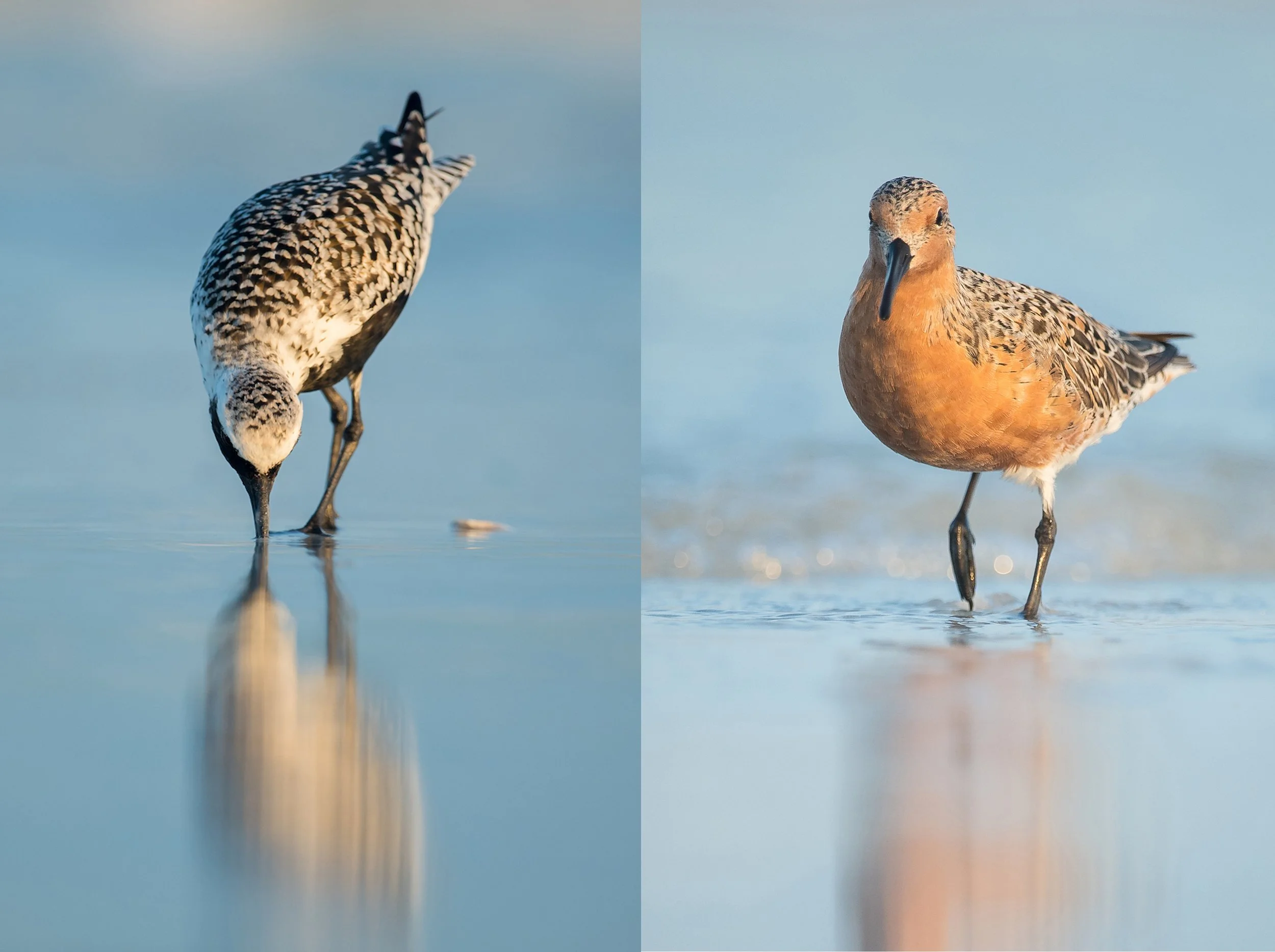
A black-bellied plover on the left and a red knot on the right. Both birds are still donning their breeding plumage even after thousands of miles of migration from the Arctic.
But here's the best part, and why you should be taking note of this: because the breeding season is so compressed for these arctic shorebirds, they are all still at the peak of their breeding colors right now as they arrive back.
Everywhere else across the Northern Hemisphere, birds are molting right now. They are dumping all those beautiful feathers for drabber attire. Waterfowl have moved into their eclipse phase. Warblers are getting dull. I was picking up the nuptial breeding plumes of great egrets a month ago. But not the shorebirds. These guys are flying in wearing their full regalia.
Far from being a month when everything starts to die down because of the heat, July is actually one of the best times of the year for photographing shorebirds all across the Northern Hemisphere.
Least sandpipers, both greater and lesser yellowlegs, and dowitchers have been back for a couple weeks now. Others, such as the black-bellied plover and red knot, are starting to show up as far south as the Outer Banks of North Carolina. And so the procession of birds will continue until the end of August.
It's important to remember that shorebirds aren't limited to beaches. These birds spill into every wetland, every river bottom, every riparian zone, across the continents. So, it doesn't matter if you are in Madrid, Iowa or Madrid, Spain. Shorebirds are heading your way.
If you're a wildlife photographer who is looking for something unique to find and photograph right now, then turn your attention to the shorebird migration, because outside marine mammals and bears of the Pacific Northwest, it's the biggest show in town.
P.S. Most of what I discussed here is hinged around a concept known as phenology. Think of phenology as the study of "nature's calendar," or the timing of natural events in relation to triggers such as the ratio of day to night or the peak of insect abundance in the arctic, and how these things trigger a cascade of other events. For wildlife photographers, understanding that every animal on Earth lives and dies by their own phenological calendar is important because it means you can predict exactly when and where things you want to photograph are going to happen. In other words, phenology takes a lot of the guess work out of this thing we call wildlife photography and makes a lot of behavior predictable. If that's something you want to learn more about, I have a feature article about this topic in the next issue of PhotoWILD Magazine.