
Want to find wildlife? Look for mushrooms.
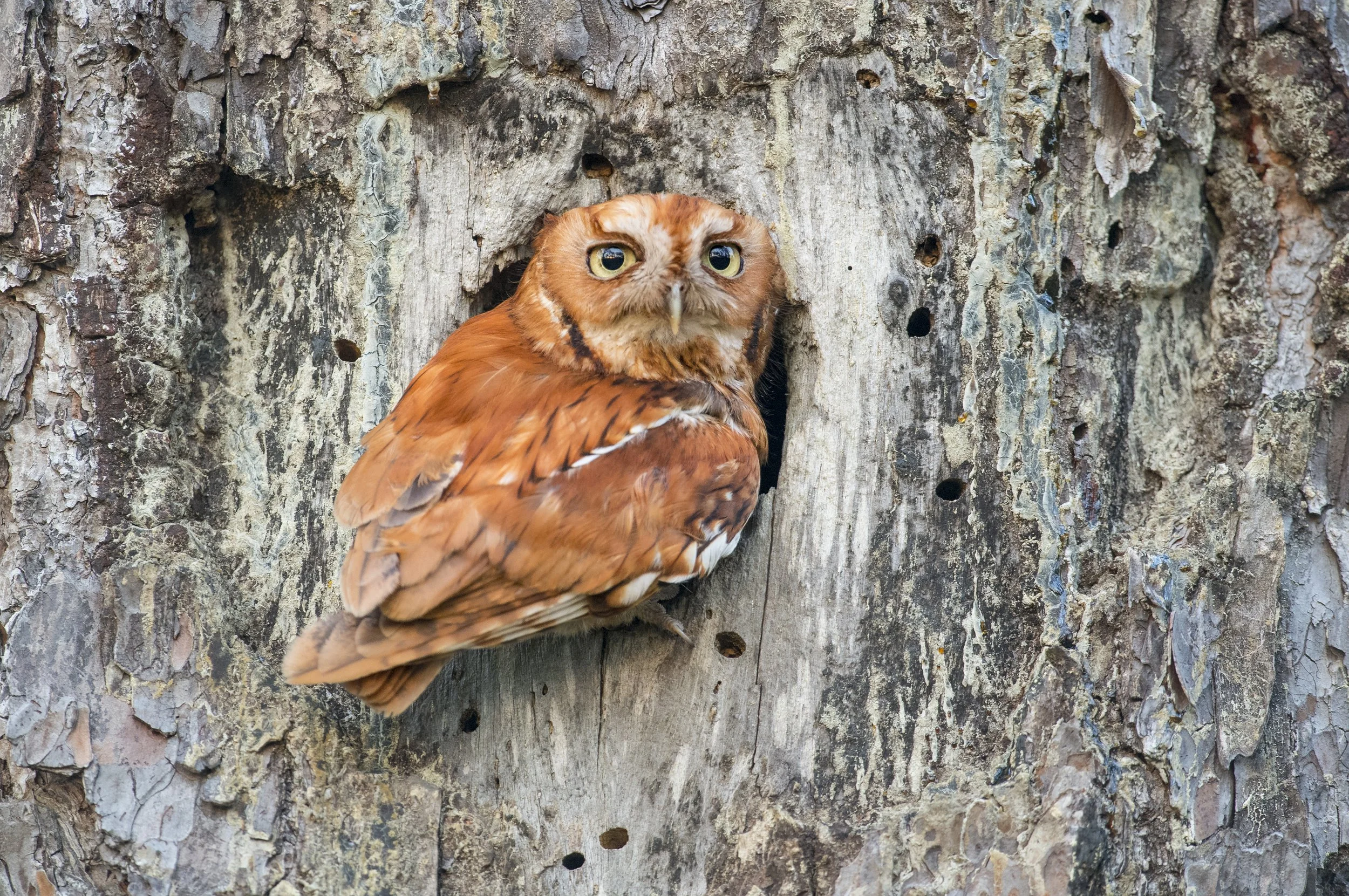
A red morph eastern screech owl sits at the entrance to a nesting cavity in a dead pine tree. Learning to find active cavities in trees isn’t just about finding woodpeckers. It’s estimate that 30% of the bird species in North America all use abandoned woodpecker cavities, along with scores of mammals like flying squirrels and American Martens.
Did you know you know mushrooms will tell you where to find wildlife?
No. Not that kind of mushroom.
Nor is it the one growing in your lawn or the one with the green caterpillar sitting on top smoking a hookah.
If you've spent any real time in a forest, you've walked past hundreds of these and probably never even noticed them. They don't look like mushrooms the way we picture them. You won’t find a cap and stem or any anything delicate. Instead, they look like a hard little shelf, jutting straight out the side of a tree. Sometimes they’re no bigger than your palm, sometimes they’re bigger than a dinner plate. They’re slightly woody and almost cork-like.
These are called conks.
And if you're serious about finding wildlife in the forest, they're about to become one of the most important tools in your kit.
Woodpeckers, those great ecological engineers of the forest, can't excavate a cavity in just any old tree. Solid, healthy wood is too dense, too hard, too structurally sound for them. What a woodpecker needs are trees that have been compromised on the inside while staying intact on the outside; soft enough to carve a chamber into, but strong enough that the tree doesn't just topple over once the hole is drilled out and the wind blows.
That’s pretty tough to come by. So, the birds get help by partnering with fungus.
Every woodpecker you see has spores of fungus on its beak. And when one of these birds explores a tree for insects, they inoculate it with the spores of the fungus.
Once established, the fungus spreads through the heartwood of the tree, breaking down lignin and cellulose, slowly turning solid wood into something closer to Styrofoam. Meanwhile, the tree's living tissue, the outer band that actually keeps it alive, stays largely untouched. The tree keeps standing, keeps growing, keeps looking healthy from the outside, while its interior is slowly being quietly converted into something else.
Years later, when the fungus is mature and ready to reproduce, it does what fungi do: it sends out mushroom. Only, in the case of heartwood fungus, that’s the conk. This is the fungus's reproductive organ, poking through, announcing that this tree has been compromised on the inside in exactly the way a woodpecker needs.
Woodpeckers see these conks in ways we can’t. Thanks to their ability to peer into the UV spectrum of light, fungus and their mushrooms probably look like glowing webs and orbs on the side of a tree.
Research backs this up.
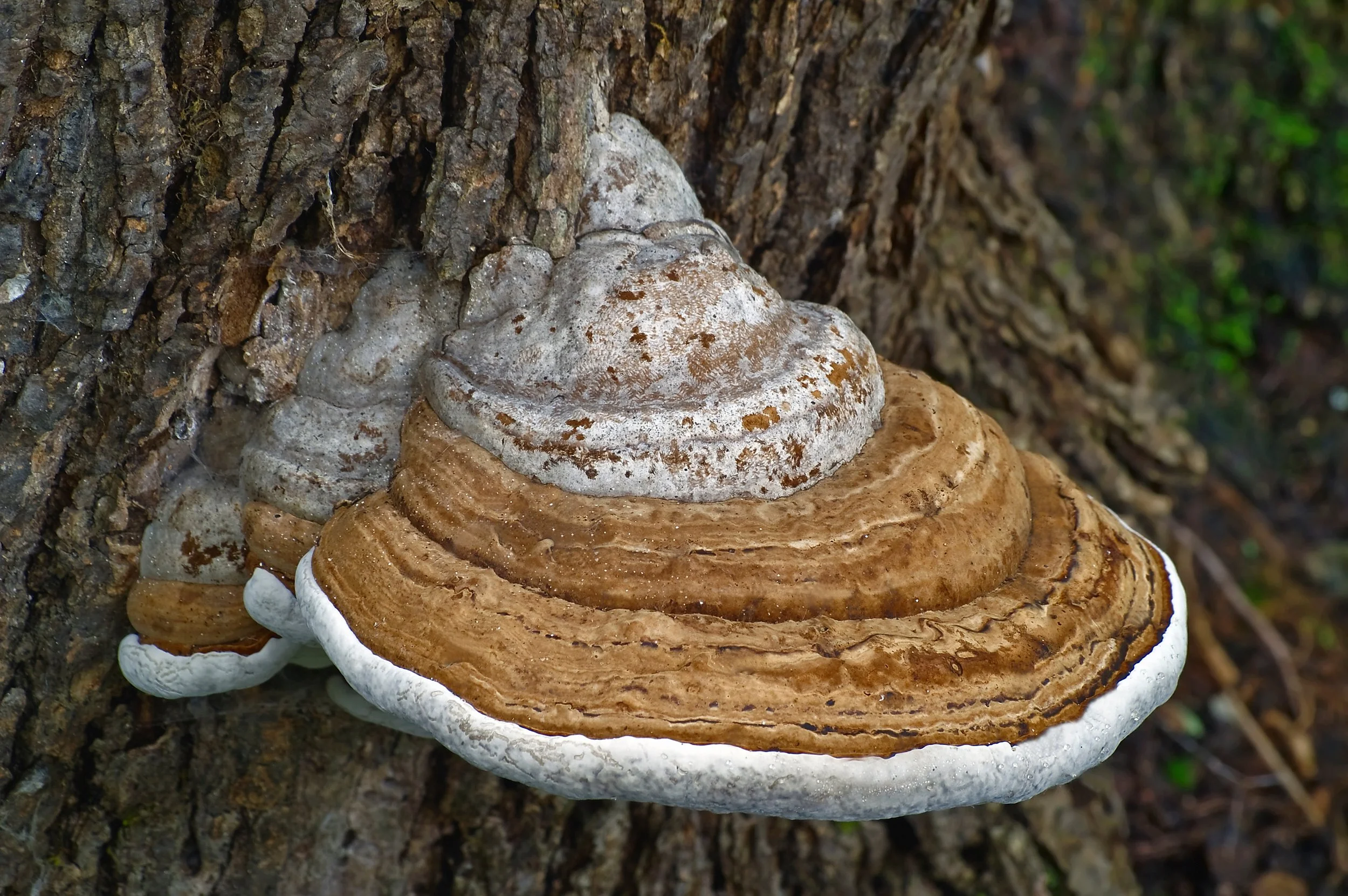
A conk growing off the side a decaying tree. Every species of heartwood fungus produces conks. The color of the mushrooms isn’t important. What you need to learn to recognize is the shape and its presence on trees.
Studies show that not only do woodpeckers have the ability to see fungus, especially heartwood fungus growing on trees, but they are able to differentiate between species. From lab tests to boots-on-the-ground studies, everything in the scientific literature points to the notion that woodpeckers know exactly what they’re doing out there.
And here’s the kicker.
Researchers have also measured this relationship between these birds and fungus across an enormous range of forests, and the pattern holds with a consistency that's truly rare in ecology.
In aspen groves across the Rocky Mountains, 70% of nesting trees all showed visible conks. In stands of western larch, favored by pileated woodpeckers in the Pacific Northwest and Northern Rockies, that number was even higher. In the yellow birch forests of the Great Lakes Region, Canada, and New England, the type of trees preferred by yellow-bellied sapsuckers, 100% of the cavity trees showed conks. In the oak, maple, and hickory forests of the East, around 75% of the nesting trees had those weird mushrooms sticking off of them.
Different birds. Different fungi. Different forests, separated by thousands of miles. But the exact same pattern, over and over again.
And this holds true around the globe. Every species of woodpecker on Earth has a unique symbiotic relationship with fungi.
For us wildlife photographers, we don’t need to know the species of the fungus. We just need to know the shape of the conks and the fact that there’s likely nesting cavities nearby.
This changes how we look at a forest when searching for animals.
Most people looking for cavities do it the hard way, walking around staring up into trees hoping to spot a small hole. They miss 90% of the potential nesting cavities this way.
Conks flip the script.
Instead of looking up in the canopy for holes, you can do what researchers do and just scan the forest around you for the mushrooms.
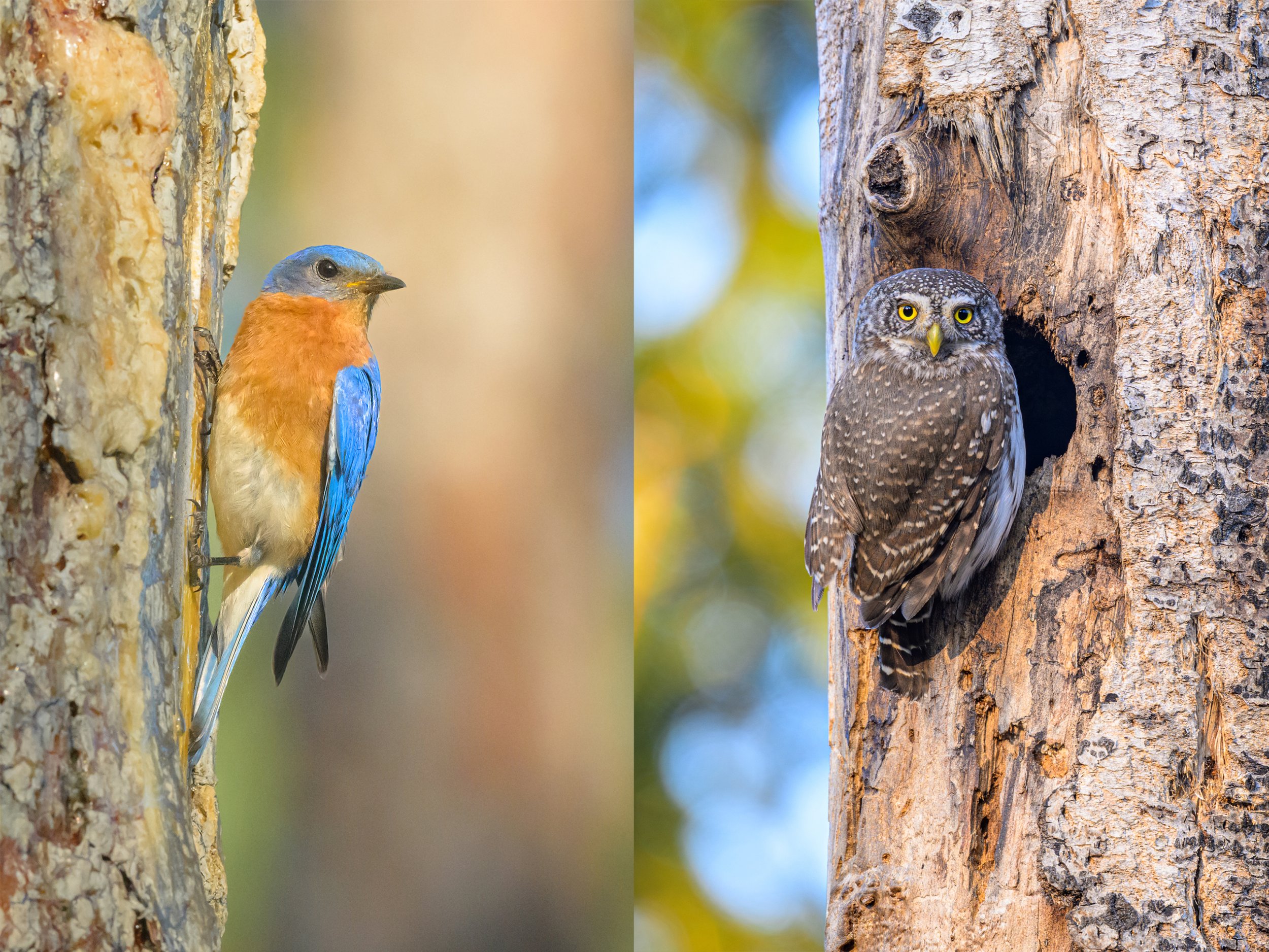
Whether it’s eastern bluebirds in North America or Eurasian pygmy owls in the taiga of Northern Europe, understanding that the presence of conks means a tree primed for cavity nesting can transform your days spent in the field searching for wildlife.
But this isn’t just about finding woodpeckers. Remember, these birds are ecological engineers and are responsible for 99% of the forest’s used housing market. Owls, songbirds, flying squirrels, fox squirrels, a cornucopia of ducks, kestrels, and martens all use these old woodpecker cavities.
In other words, find the conks and you can also find other animals as well.
Case in point. This past spring, there was a northern saw-whet owl nest that everyone around the Minneapolis area was photographing. Some of you reading this likely know exactly what I’m talking about. I saw images of this for weeks on my Facebook feed. And right there beside the cute little face of an owl peering from her nesting cavity was a conk. I came very close to jumping on a plane and flying out there to photograph it simply because of how perfectly it illustrated this ecological concept.
Next time you're out, pay attention for these little mushrooms we call conks. They’re unique to heartwood fungus. And as the research shows, most of the trees with nesting cavities in them also have conks growing off the side of the trunk.
P.S. When it comes to finding wildlife in the forest like this, understanding what a conk is and what they mean is just the beginning. Patterns like this repeat over and over again. For instance, studies show that 95% of all nesting activity only occurs in 15% of the forest. Knowing what part of the forest this can be a game changer if you a wildlife photographer or even someone who just enjoys looking at birds. And there’s a real collective benefit for wildlife gained from clustering their homes together like this. In the last issue of PhotoWILD (Spring 2026) I wrote an article about this and how you can find which 15% of a forest that is near you.